Most productivity tools are quietly hostile. Nudge is our attempt at the opposite: a small reminder system, running inside a real team, built to keep people moving instead of making them feel behind. This note is a proof, so the scope comes first and the limits get their own section.
scope
- What it is: a reminder system that pings the one person who owns a task, in the chat the team already uses.
- Where it runs: inside a design studio we work alongside, since early 2026. Its modules were later reused for a restaurant team (how that worked).
- Built with: n8n, plus Telegram and Discord as the channels.
- What we measured: nothing with a number on it yet. Everything below is what we saw in the channels and what the team told us.
- What we're not claiming: that it raised output, that it saves money, or that it would work the same way for any team.
the problem
Most tools pile up notifications, turn tasks into debts, and slowly stop feeling like help. At some point the thing meant to support you starts feeling like a manager reading over your shoulder.
Nudge wasn't designed from the outside. We built it inside the studio's actual routine, watching how work already moved there, and shaped the system around that. That's how the lab prefers to work: the question gets tested where the work happens, not in a demo.
It started as a boring question — how do we remind people about tasks — until we realized we were asking the wrong one. The team wasn't disorganized. They knew exactly what needed doing. What they were losing was momentum. Their tools were great at tracking work and terrible at sustaining it.
So we threw the question out. Not "how do we get people to finish tasks." "How do we help people feel like they're moving."
the flip
One decision changed everything: stop treating a notification as an alert, start treating it as a moment of reinforcement.
Sounds like nothing. It's the whole thing. A reminder whose job is encouragement is a completely different object than one whose job is accountability. The language stops being about overdue work and starts being about progress. We stopped building something that pressures people. We started building something that keeps them going.
Nobody needs more pressure. They need a reason to keep going.
how it actually works
Small on purpose. It stays out of the way.
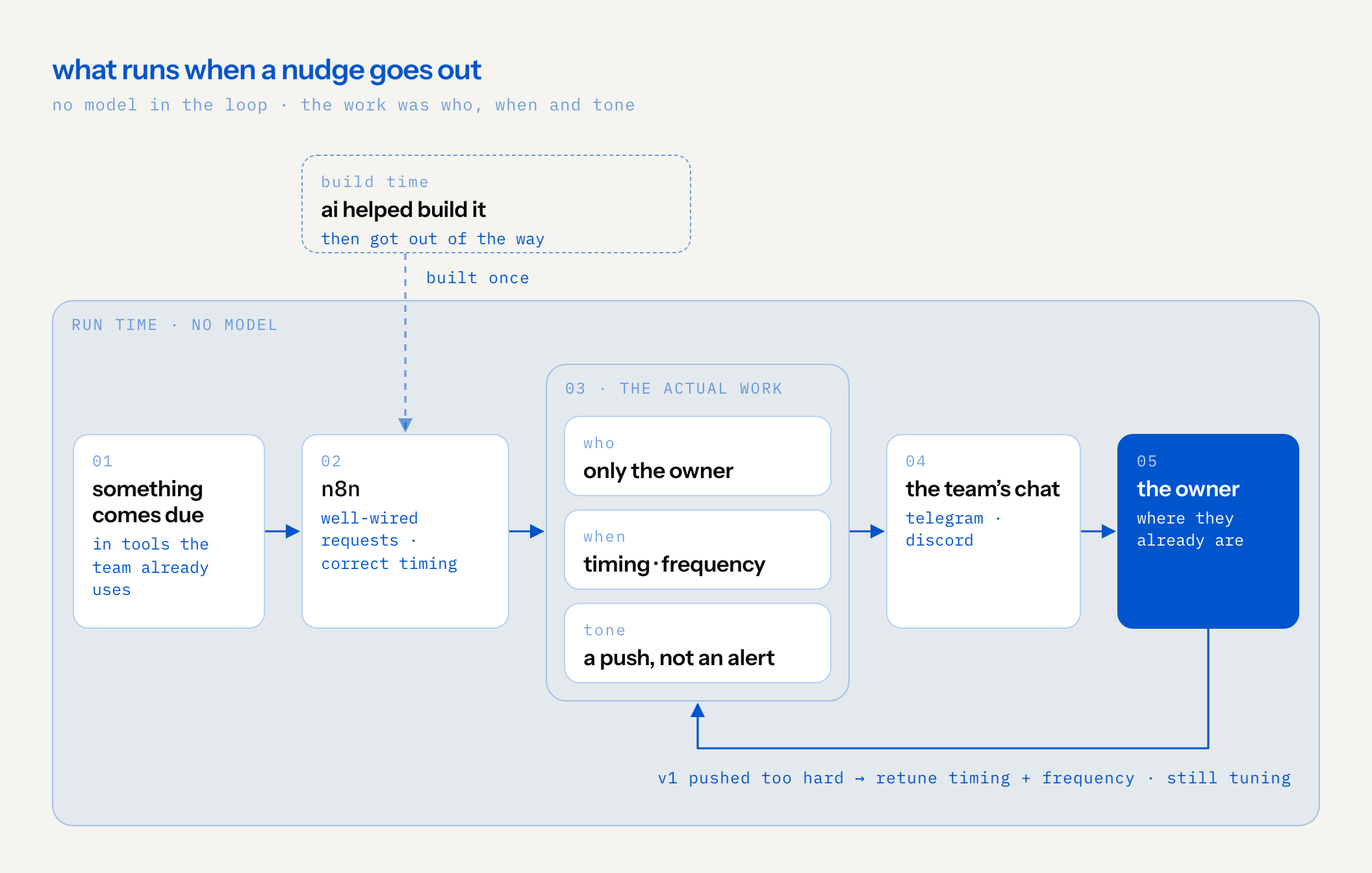
- It runs on n8n, bolted alongside the tools a team already uses instead of replacing them.
- It speaks through whatever channel the team already lives in — right now Telegram and Discord — so there's nothing new to adopt and no dashboard to forget about.
- When something comes due, it nudges the one person who owns it, where they already are.
Most of the work wasn't features. It was who, when, and tone.
no magic
Worth saying plainly: Nudge isn't a big AI model running in the background, spending tokens to watch your team and decide things for them. The AI did its part earlier — it helped us build the thing — and then got out of the way.
What's actually running is unglamorous on purpose: a set of well-wired requests with good semantics and correct timing, shaped by behavioral science — triggers, small habits, a little game-like feedback. The intelligence lives in the system design, not in a model deciding for you.
We think most of the genuinely useful AI right now looks like this. Less "the AI does it all for you," more "use AI to build a small system that does one real thing well." That's the posture of the whole lab. It also means most of what runs isn't a model at all, so the model bill is a small part of the cost. We haven't put a number on it, and we're not going to guess one here.
what we saw
Qualitative observations, from the channels and from talking to the team. None of these are measurements.
- The win wasn't the notification. It was killing the checking ritual — that background tab in everyone's head labelled "things to follow up on." The system handles it. You stop carrying the list in your head.
- A nudge in a shared channel is gently public, and follow-through seemed to improve without anyone policing anyone. We saw it; we didn't count it.
- The first version pushed too hard. Dialing in frequency and timing — so it lands like a good teammate and not an alarm clock — turned out to be the actual job. Still tuning it.
Underneath all of it sits the real lesson: friction is emotional before it's operational. People don't skip a task because no one reminded them. They skip it because the pile of unfinished work is heavy, and one more alert just makes it heavier. Nudge pushes from the other side.
limits
- No hard metrics yet. The two signals we said we'd watch are whether people actually engage with the nudges and whether overdue work goes down. We haven't published either.
- One team, then a second. What held in a design studio may not hold in a team with a different rhythm. The restaurant reuse is a sign it travels, not proof that it does.
- We built it, and we watched it. The people judging whether it worked are the same people who made it. An outside read would be stronger.
Update, Oct 17: Nudge is still running. We still don't have numbers for those two signals, so read this as a proof that the system runs and that the design shift held up in daily use, not as a proof that it moved output.
The bet we're trying to prove: a little encouragement, timed well, beats endless reminders of obligation.
Small system. But it handed us a rule we keep building on — meet the work where it already happens, and design for momentum, not compliance. Nobody needs more pressure. They need a reason to keep going.