A small team had years of group chat — the way any long-lived group accumulates it: jokes, plans, arguments, half-finished ideas, real decisions, and an ocean of noise. Somewhere in there is genuinely useful stuff. Nobody was ever going to read it all. That's not laziness — it's volume. The archive outgrew human attention years ago.
Here's the part that still gets me. This used to be a big-company move. Processing a decade of internal conversation was something only a corporation could afford to attempt — and even when they did, what they got back was numbers. Growth, counts, sentiment trending up and to the right. Dashboards. Never "this specific idea, buried eighteen months deep, is worth reviving on Monday." A ten-person studio can now do the granular version that no enterprise ever could. That's the whole reason this was worth writing down.
the wow: surfacing, not summarizing
The goal was never a tidy paragraph. It was recovery — dragging back the things that got lost. The workflow went looking by signal: ideas that drew a pile of reactions, threads that suddenly ran hot, moments where the conversation clearly mattered to the people in it. Surface those, and a human picks or dismisses. That's it.
What comes out is a base you can return to. Not "here's what your community is about" — that you already know. It's "here are forty specific things you said and forgot, and three of them are gold." The value isn't compression. It's memory. The same surfaced base turned out to do double duty, too: we used it to audit ourselves — what connected to what, what was working, what quietly never did — and to reorganize around the answer.
what breaks (and it's the whole point)
Ask the same AI to summarize that pile instead of surface it, and it hands you something fluent, confident, and partly invented. Not because it's lying — because summarizing compresses, and when it compresses it flattens "someone joked about doing X once" and "we actually decided to do X" into the same calm sentence: "the group does X." Those are wildly different facts. One is a passing comment, the other is history. Blurred together, random ideas get promoted into roadmap-looking facts, and you get a document that quietly invents a past that never happened.
Two failure shapes showed up over and over, and naming them matters more than "it hallucinates":
- It can't hear tone. Jokes got promoted into plans. Sarcasm got read as sincere. The thing a human catches instantly — they obviously didn't mean that — is exactly what the machine flattens. It felt cultural, even: the more a group speaks in dry, ironic shorthand, the worse it gets.
- It has no memory of what already shipped. It would surface an early idea and present it as fresh and new — when that idea had been built, launched, and sunset long ago. It wasn't wrong about the message. It was blind to everything that happened after it.
This is the danger far beyond chat logs. Any time you ask AI to digest a big human record — meeting notes, customer emails, an archive — the risk isn't a wrong fact. It's that it launders a guess into a fact by stating it in the same voice as the things that are actually true.
what we built
Four moves, in order:
- Surface by signal, not by summary — pull the high-reaction, high-heat moments out of the noise, as raw material a human reviews.
- Forbid the flat summary — every item the AI pulled had to come tagged with what kind of thing it is. An idea: somebody floated this once; might be gold, might be nothing; unconfirmed. A fact: this actually happened or was actually decided, and here's where it's backed up. "Someone suggested this" and "this is true" are never allowed out in the same voice.
- Ground it against everything else we know — the chat alone has no idea what got built, so we cross-referenced the surfaced claims against the team's other records — the docs, the code, the project tracker. That's what catches the already-shipped trap, demotes the confident-but-stale, and turns "the AI thinks this is new" into "we can see this shipped and died, it's in the second record."
- Then do data science on it. This is the move I'd have skipped a year ago and now think is the whole point. Steps 1–3 weren't the product — they were the prep work: the unglamorous part that turns a decade of messy prose into a structured dataset (engineers call it ETL — extract, clean, structure). Every surfaced thing is now a row with attributes — what kind of claim it is, how much heat it drew, where it lived, whether it's grounded in another record or not. Once it's a dataset, you point a different AI at it and ask it to recombine — mix and match the points to surface things no single read could ever see. And when a row earned its place, it drilled back into the raw dump to pull the real, verbatim original.
The recombinations are the finds, and none of them live in any single message:
- High reaction × proposed × never built → the revive pile: good ideas the room loved and quietly dropped.
- A question raised → never resolved → raised again later → an unclosed wound: a single complaint is noise, the same one recurring across months is a finding.
- A whole coordination thread going silent → a structural signal that lives in the metadata, not in any message at all — work moved somewhere, or stopped being written down.
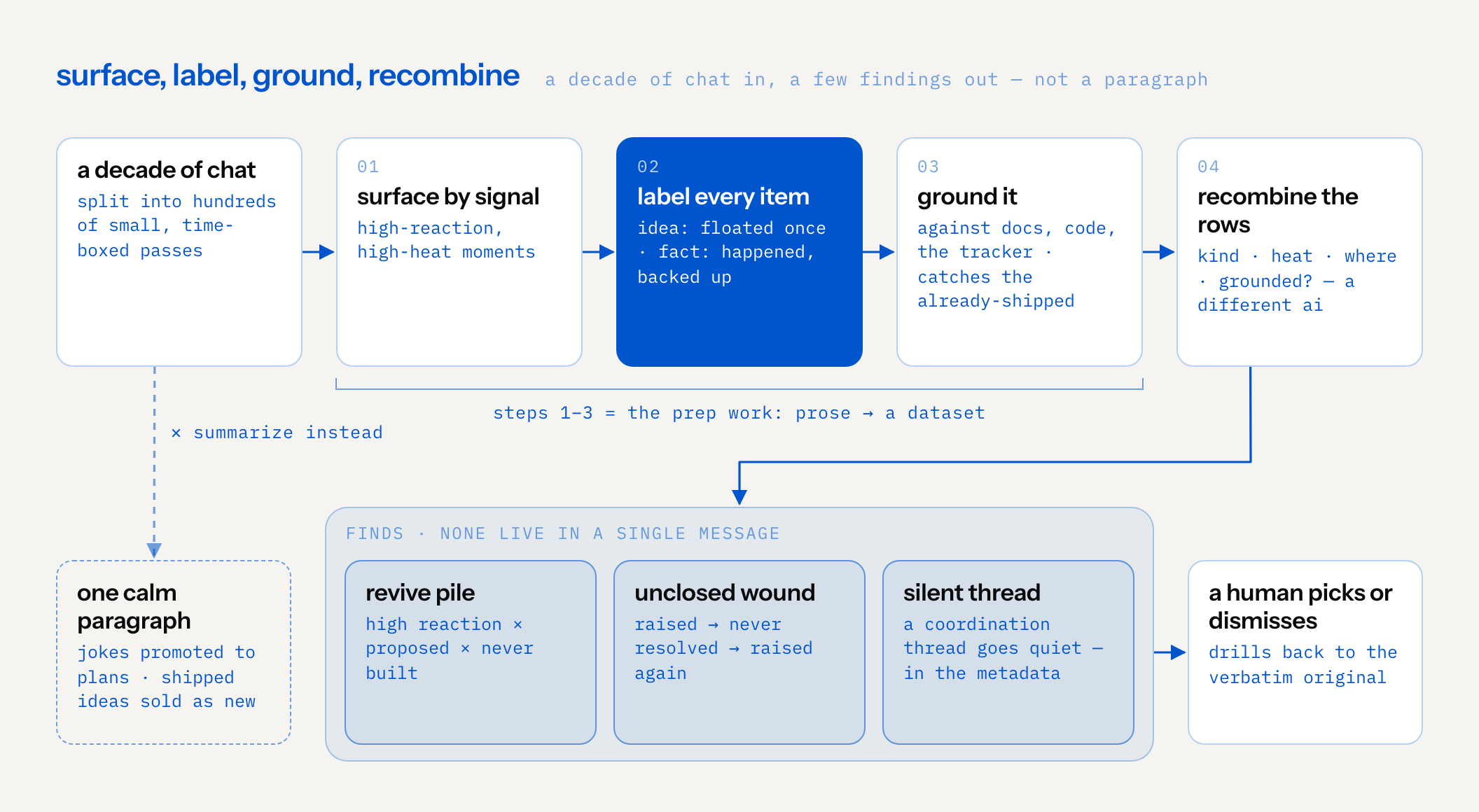
Mechanically it wasn't one big read. The archive was split into hundreds of small, time-boxed passes — more of them aimed at the busiest threads, fewer at the quiet ones — so no single pass had to hold more than it could honestly carry. The final call was always a human picking and dismissing, not the machine deciding.
One more thing worth saying: once the workflow existed, it stopped being one project. What started as a single experiment on one archive plugged straight into two more — same machine, different data, different ground-truth to check against. The reusable part wasn't the answer. It was the way of asking.
the lesson
Three, and they stack:
The granular archaeology that only big companies could attempt is now a small-team move — and the small-team version is better, because it surfaces specific buried value instead of aggregate numbers. That's the wow.
It's only trustworthy if the unit of output is a claim wearing a label that says how much to trust it — never a smooth summary. Force the machine to tell you which things are ideas and which are facts, verify the ones claiming to be true against the originals, and ground the whole thing against your other records so it can't re-propose the past as the future.
And the labeling step was secretly the hard part paying off. The real payoff wasn't the cleaned list — it was that you'd quietly turned your prose into a queryable past, and the best finds came from running questions against it, not from reading it. A summary that hides its own uncertainty isn't a summary. It's a confident-sounding rumor. But a labeled, grounded dataset of your own history is something you can actually ask questions of.
the catch
This is not free, and it is not magic.
- It's slower and the output is less pretty. Labeled lists, cross-checks and a dataset beat one clean paragraph, but they look worse. You trade polish for trust, on purpose.
- The grounding is only as good as the records you check against. No second source — no real verification, just a second opinion. The magic move (catching the already-shipped idea) only works because the other records existed to catch it.
- Tone is still the soft spot. Sarcasm and inside-jokes slip through more than anything else; the labels lower the stakes of getting one wrong, they don't drop them to zero.
- The recombination only works because the cleanup was honest. Mix and match unreliable rows and you get confident nonsense, faster. The data science is downstream of the discipline — not a shortcut around it.