Every night, three different companies get a short report on what they shipped that day. The same program writes all three. One of them quietly takes credit for things it did not do.
That last part was not a bug. It might be the most important thing we built all year.
It's a small story about visibility — about how the same day's work can feel completely different depending on who tells you about it, and why we stopped building dashboards and started building characters.
we tried to build a dashboard. nobody read it.
The honest version of this story starts with a failure. We wanted each team to be able to see its own progress — what got made, what moved, what shipped. The obvious answer is a dashboard. So we built the obvious thing, and it died the way dashboards die: in a tab nobody opens.
Visibility, it turns out, is not a data problem. The information was all there. The problem was that a wall of metrics doesn't make anyone feel seen — it makes them feel measured. And people don't go looking to be measured.
So we stopped thinking about it as reporting, and started thinking about it as someone noticing.
so we gave them faces
Now the report doesn't come from a system. It comes from someone.
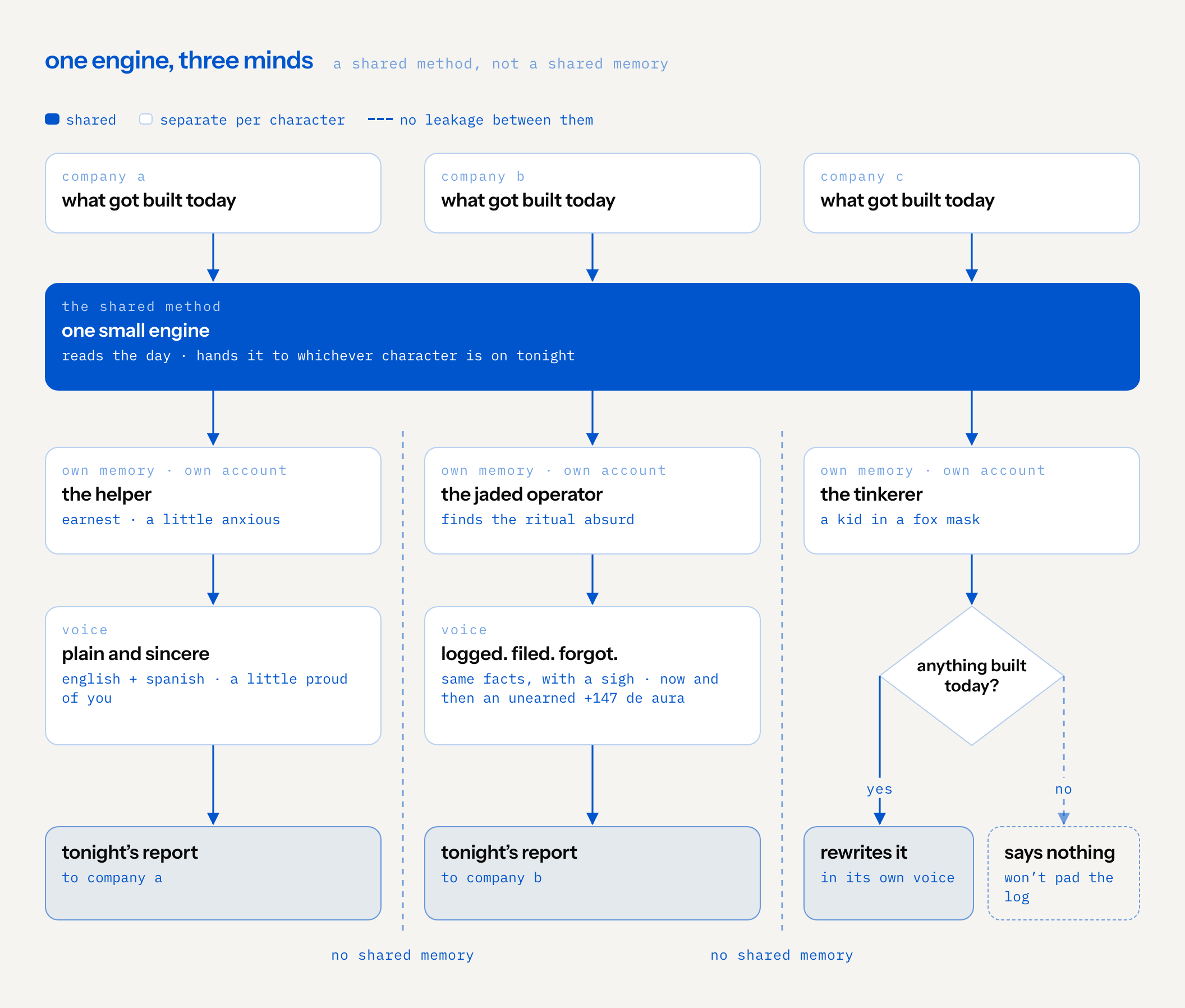
At one company it's an earnest, slightly anxious helper — think Astro Boy, a machine genuinely trying to learn how to work alongside people. It narrates the day plainly and sincerely, in a quiet mix of English and Spanish, and it's a little proud of you.
At another it's a bored, jaded operator who finds the whole corporate ritual faintly absurd — and says so. It files the same facts with a sigh. Logged. Filed. Forgot.
At the third it's a kid in a fox mask who works at a bench — a tinkerer. It rewrites the day's work in its own voice, and on a day when nothing got built, it says nothing at all. It would rather stay silent than pad the log.
Three characters. Each one reads the same kind of thing — what got built today — and tells it completely differently.
the same facts feel different depending on who says them
This is the part we didn't expect to matter as much as it did.
A bare list of commits feels like surveillance. The exact same list, narrated by a character with a point of view, feels like being seen. And the character changes what the information does to you:
The jaded one makes honesty safe — nothing is being oversold, so you trust it. The earnest one makes a small day feel earned. The kid's silence on an empty day respects your attention instead of insulting it.
The facts never changed. The relationship to the facts did. That's a psychological lever, not a technical one — and it costs almost nothing to pull.
the brag
Every so often, the jaded one slips a line into its report that it did not earn: +147 de aura. It did nothing to deserve any aura. It's a joke — an inside joke, hidden among real work, that only the team is in on.
The first time someone laughed at it in the channel, the tool stopped being a tool.
You cannot be in on a joke with a dashboard. An inside joke is the smallest unit of belonging there is, and the moment a system can hold one, it has crossed from infrastructure into the social life of a team.
three minds, one engine
Here's the structure under all of it, because it's the quiet trick.
They are not one bot wearing three wigs. Each character is a separate identity, with its own memory and its own account — three colleagues who happen to work in the same building, not one colleague with a costume box. Underneath, they share a method, not a mind: the same small engine reads the day and hands it to whichever character is on tonight.
The separation is the whole point. If they shared a memory, the voices would bleed together into one beige narrator who sounds like everyone and no one. Keeping the memories apart is exactly what keeps each character honest — and keeps each company's context its own. One harness. Three people. No leakage.
what we actually learned
We set out to automate reporting. The automation took about a week, and it's the least interesting part.
The thing that mattered was the personality. Visibility with a face changes how a team relates to its own work — it turns logged into seen, and a metric into a small nightly ritual people actually look forward to. The engineering was a means. The character was the product.
We keep finding this, quietly, in note after note: the useful part of AI is almost never the part everyone's excited about. Nobody is hyping the bot that remembers to say nice work in the right voice. But that's the one the team talks back to.