Every week, 2fifty Texas BBQ sends a newsletter to almost 90,000 people, and putting one issue together used to take the designer up to two working days. The first issue built with the system we made for them went from the restaurant's own website to a client preview in about 2.25 hours of person time. The restaurant didn't hire a team to get there. It shares one with other businesses. This note is about that model: what it is, the evidence so far and where it stops. It is a thought piece, so read it as our position.
the gap
Plenty of businesses have a real problem that AI could help with and nobody to put on it. A restaurant, a design studio, a small team that runs on its own reminders: none of them can pay eighteen engineers to find out what AI should do for them. They also can't afford to fall behind while they wait for the tools to settle.
The usual options fit that gap badly. Hiring a team is out of reach. A generic tool is quick to set up and gives up whatever makes the business itself. A one-off project ends with the handover, and nobody is left to tune the system when the work changes.
the model
CAPSLOCK is a shared innovation and systems layer. Several businesses draw on one lab: we design, build and run systems inside their work, and what holds up in one place makes the next build better.
In practice that means three things:
- We build inside the work. The system is shaped around how the team already works, in the tools it already uses. The deciding stays with people.
- We keep it running. A system that talks to a team every day has to be tuned, and the tuning turns out to be much of the job.
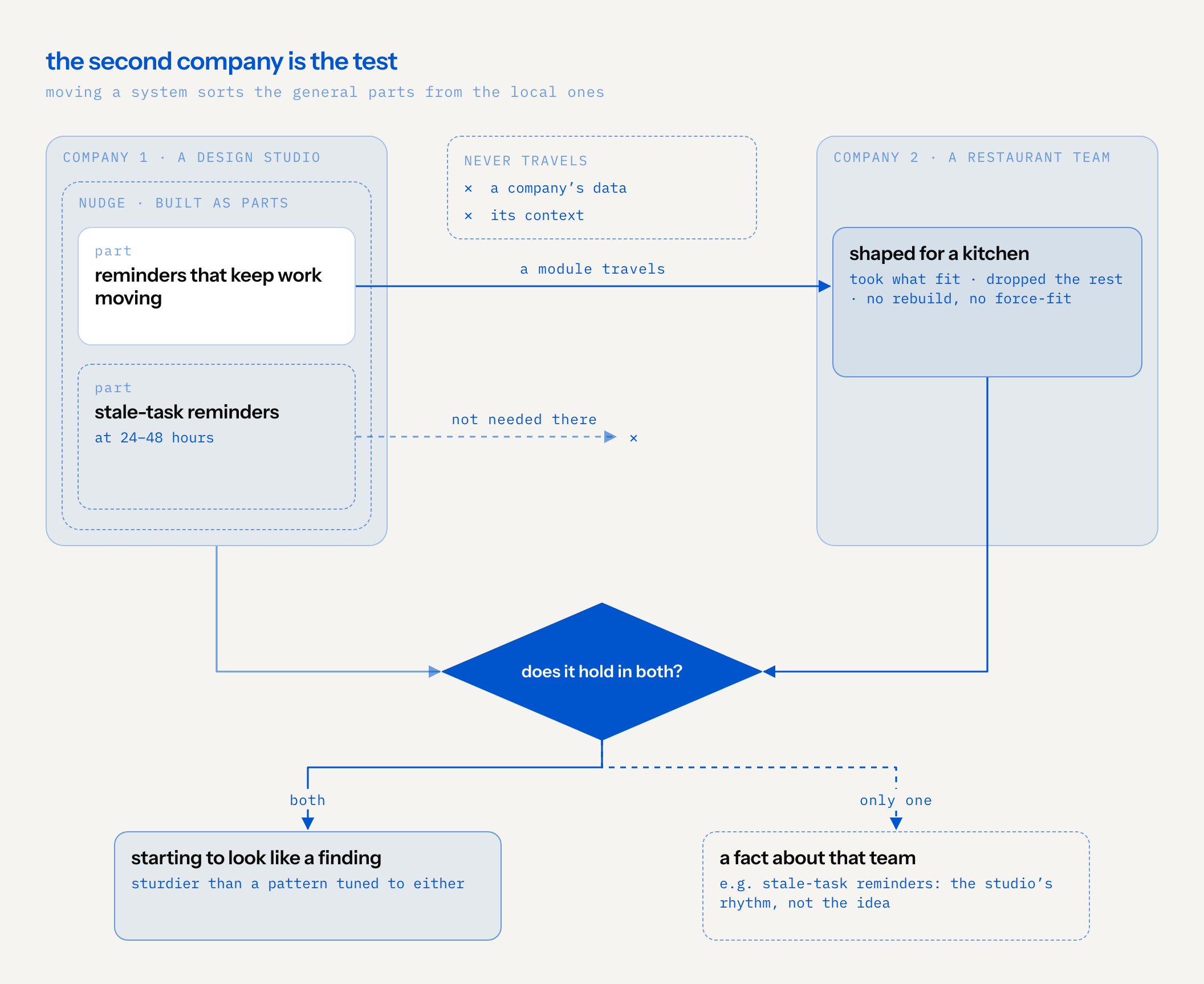
- What we learn carries. A method or a module moves from one business to the next. A business's data and its context never do.
the evidence so far
a client: 2fifty texas bbq
2fifty Texas BBQ is a restaurant with two locations, and its weekly newsletter is one of its best sales channels. We built a custom skill around a block system we designed for them. It starts from the client's brief, reads the specials, the seasonal page and the news on the restaurant's website, reuses the copy and the photos verbatim, and leaves a [bracket] wherever the website is silent. The client comments on one preview link, and the export hands over every image, link and alt text ready to upload.
The designer's own estimate for an issue before was about 16 hours. The first real issue took about 2.25, so about 13.75 hours back per issue. The before column is an estimate and the after column is one issue, so all of it is an estimate for now. The case is on work, and the method and the full hours table are in the fieldnote.
two systems built with a design studio
The other evidence comes from inside a design studio we work alongside. Two systems came out of that work, co-created with the studio's team:
- Nudge keeps a team's work moving. It lives in the channel the team already uses and reminds the one person who owns a task. It runs every day and keeps picking up new jobs, each one added when the team caught itself doing something by hand. There are no hard metrics on it yet.
- Brand Brain serves a brand's strategy, identity and voice to the AI tools a team already uses, so every conversation starts with the brand loaded. Before the first client's team logged in, it went through more than 130 scripted conversations with synthetic users. It is live with its first brands.
what carried between them
This is the part a single company can't show. Nudge was built as parts, on purpose. When a restaurant team later needed something in the same shape, we took the modules that fit and dropped the ones that didn't, like the 24 to 48 hour stale-task reminders that mattered in the first build. Those turned out to belong to the studio's rhythm, and we only learned that because there was a second place to try them.
Rules carry too. Brand Brain is built to leave an honest placeholder when a brand doesn't hold a fact. The newsletter skill does the same with its brackets, and we wrote the rule down first when we rebuilt 24 case studies in an afternoon: only what the source says. Three builds, one rule.
And one connection is in progress: plugging the brand connector into the newsletter skill, so the restaurant's voice and visual rules are loaded from the start. We'll write down what it changes once it runs.
who owns the code
Sharing a lab doesn't mean sharing your system. You own the code you pay for. If you'd rather not run it yourself, we can host and maintain it for you, and you can take it over whenever you want. We keep the general methods and tools we bring to every project, and we publish lessons, never your name, your data or your code.
the catch
- We're small. Today CAPSLOCK is Sam, one developer and one admin. That is early, and we would rather say it plainly. It is also why we keep only a few collaborations running at a time.
- The evidence is young. The 2fifty hours are one real issue against an estimate. Nudge has no hard metrics yet. Brand Brain is live with its first brands.
- Sharing only works if you build to share. The restaurant team got its reminders fast because Nudge was designed to come apart. When we build something too specific, it stays stuck in the business it was made for.
- We're not neutral observers. We build the systems and we watch them. That is useful, and it is also a bias.
open questions
- How many businesses one small lab can serve well before the attention gets thin.
- Which parts of a system are general and which belong to one team. So far we find out build by build.
- When a business should take a system over and run it itself, and what makes that handover easy.
The longer story of where the lab comes from is in built from El Salvador. If you want to see how a project starts, collaborate has the two ways in.
(Rewritten Oct 17 as the model piece. The earlier version framed this setup as the lab's field site; the reuse example from it is kept above, and the evidence now includes a named client.)