Sam Portillo is Salvadoran, and has lived and built in Berlin for about five years, with ventures in Switzerland and the US. CAPSLOCK is the applied AI lab that came out of that path. This note is the long version: where it starts, what the work taught us, why the lab sits in El Salvador and who is here today. It is a thought piece, so read it as our position, with the open questions at the end.
where it starts
Sam's background is strategic design and business, not engineering. The work starts with questions: who is this for, what would they do with it, what does better look like. The technology comes after.
What the lab knows about AI comes from building with it inside working companies: a design studio, a Texas BBQ restaurant, a team that runs on its own reminders. Sam also works with a custom-software company that builds for enterprise and fintech, which keeps the lab close to how bigger systems get built and run.
The same pattern kept showing up. A business had a real problem that AI could help with and no way to staff it. Plenty of businesses can't pay eighteen engineers to find out what AI should do for them. They also can't afford to fall behind while they wait. CAPSLOCK started in that gap.
what the work taught us
We set out building tools, and we were wrong about one thing going in. We assumed companies were held back by access: to the right models, the right tools. They were held back by fragmentation and friction. Knowledge stuck inside teams, work surfacing in the wrong place at the wrong time. Most of the hard part sat around the AI, in how the work was already set up.
The systems that held up were small and well wired: good semantics, correct timing, real behavioral design underneath. A reminder system that keeps a team's work moving (Nudge). A weekly newsletter for 2fifty Texas BBQ that now starts from the restaurant's own website (how that was built). None of it needed a giant model thinking for anyone.
Partway through, the thing we were building stopped feeling like a service. The need was real, the benefit was obvious once a system was running, and the same lessons kept carrying from one business to the next. That is when it became a lab.
why a lab
An agency sells answers. A lab is allowed to have questions, and to be wrong about them in public. Most of what is useful about AI right now isn't known yet, by us or by the people selling it. The honest way to work inside that is to run small experiments inside real work, look closely at what happens and write it down.
So CAPSLOCK is a shared innovation and systems layer. Several businesses draw on one lab: we design, build and run systems inside their work, and what holds up in one place makes the next build better. A shared innovation layer has that argument in full, and practice shows how an ordinary week of it runs.
why el salvador
The building itself could happen anywhere. Wiring up systems, designing workflows, writing the code: none of it needs a specific country. What El Salvador gives us is the setup around the work.
- Export of services. The country is structured to export work like ours, and to sell it beyond its own market.
- A tech law. The ley de tecnología and the policy around it lower the friction of building and running technology here. We also build under the country's AI promotion law and its data protection law; AI use says how.
- A real need to innovate. There is openness and room for new systems, and less of a crowded market defending the old way of doing things.
- The middle of the Americas. Close, in practice, to the teams and markets we work with.
Closeness is the part that matters most for how we work. We build systems with a team, from inside how it already operates, and that only works at short range: same region, overlapping hours, often the same room.
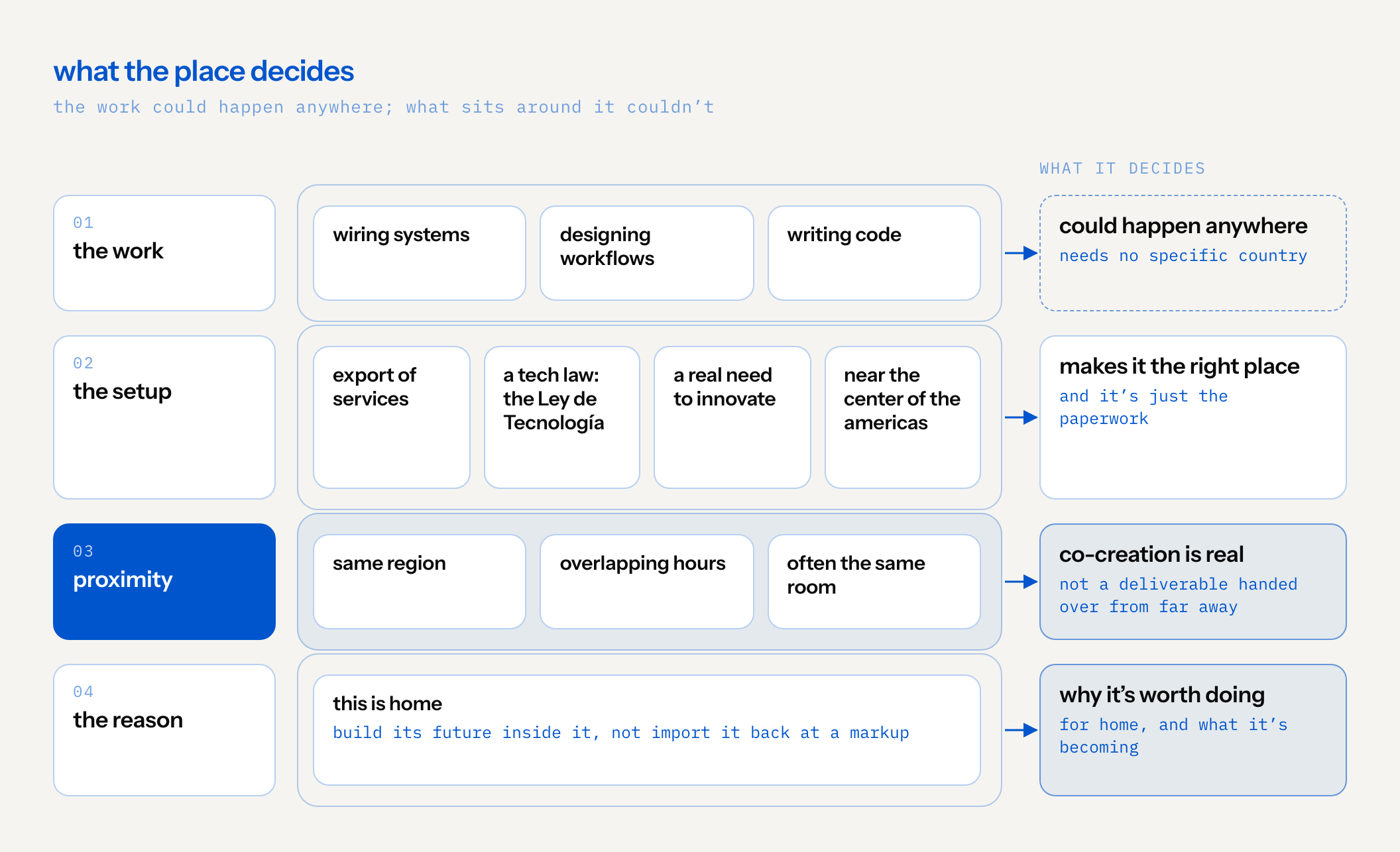
The incentives and the laws are the paperwork. The reason is that this is home. There is something different about building the future of a place you are from, for people you know, rather than watching it get built somewhere else and imported back at a markup. El Salvador doesn't need to borrow its technology. It can make it.
That is why developing local talent is part of the job: people here learning to build with these tools on real projects, and staying to run what they built. We work from El Salvador outwards, with businesses wherever they are.
who is here today
Today CAPSLOCK is three people: Sam, one developer and one admin, lean by design. Around us is a regional and international network of collaborators close to what's happening right now: investors, CEOs and CTOs, infrastructure experts and agentic engineers. We call on them when the work needs it. What the lab can do shows in the systems it runs, listed on work, and in the fieldnotes written while running them.
how we publish
The fieldnotes come in three kinds. Thoughts, like this one, are positions labelled as opinion. Experiments say what we tried, what we saw and what failed. Proofs show something running, with its scope and its limits. The failures go next to the wins, the businesses we learn alongside stay unnamed unless they say otherwise, and no number goes into a note unless we can point at where it came from.
what we don't know yet
- Whether a shared layer keeps its quality as more businesses lean on it. The lab is small and keeps few collaborations open at a time.
- How fast local talent grows when the projects are real and the team is three people.
- How much of what works in a studio or a restaurant carries into a bank or another regulated organization. That is still an open question for us.
If you are working on something with AI, or want to, write to us.