Every human-centered design process starts the same way on the whiteboard: research, then define, then make. And every small studio knows which of the three gets squeezed when the budget is real. You can't cut the making. You can rarely cut the defining. So research becomes a day of looking at competitors, a few screenshots in a Figma frame, and a sentence in the proposal that says "informed by."
That's not a moral failure. Research is slow by nature. Collecting is slow, transcribing is slow, tagging is slow, counting is slow. Most of the hours in a proper research phase are mechanical — and mechanical hours cost the same as creative ones on an invoice.
In the last year that stopped being true for us. It changed how much research we do, not just how fast.
the mechanical half
Take a study we ran this month. We wanted to understand a short-video format before making our own. The honest version of that study is: get the thirty most recent examples, transcribe all thirty, cut each into frames, time every beat, record the hook, the call to action, the length, the numbers — then look for the pattern.
Five years ago that's a week for a junior and a spreadsheet nobody opens again. We did it in a day and a half. Not because anyone worked faster — because the collecting, the transcribing and the record-filling went to agents, and the person's time went to the two parts that matter: deciding what to look at, and reading what came back.
The same shape keeps showing up. Measuring what actually gets curated on a portfolio platform before building a case study, instead of guessing. Reading a year of a client's email campaigns to find which one made the money, before proposing a new one. Auditing every channel of a community before suggesting how to run it.
None of these are new ideas. They're the studies we always wanted to do and could rarely justify.
what we insist on
Cheap research is easy to do badly. Four things, non-negotiable.
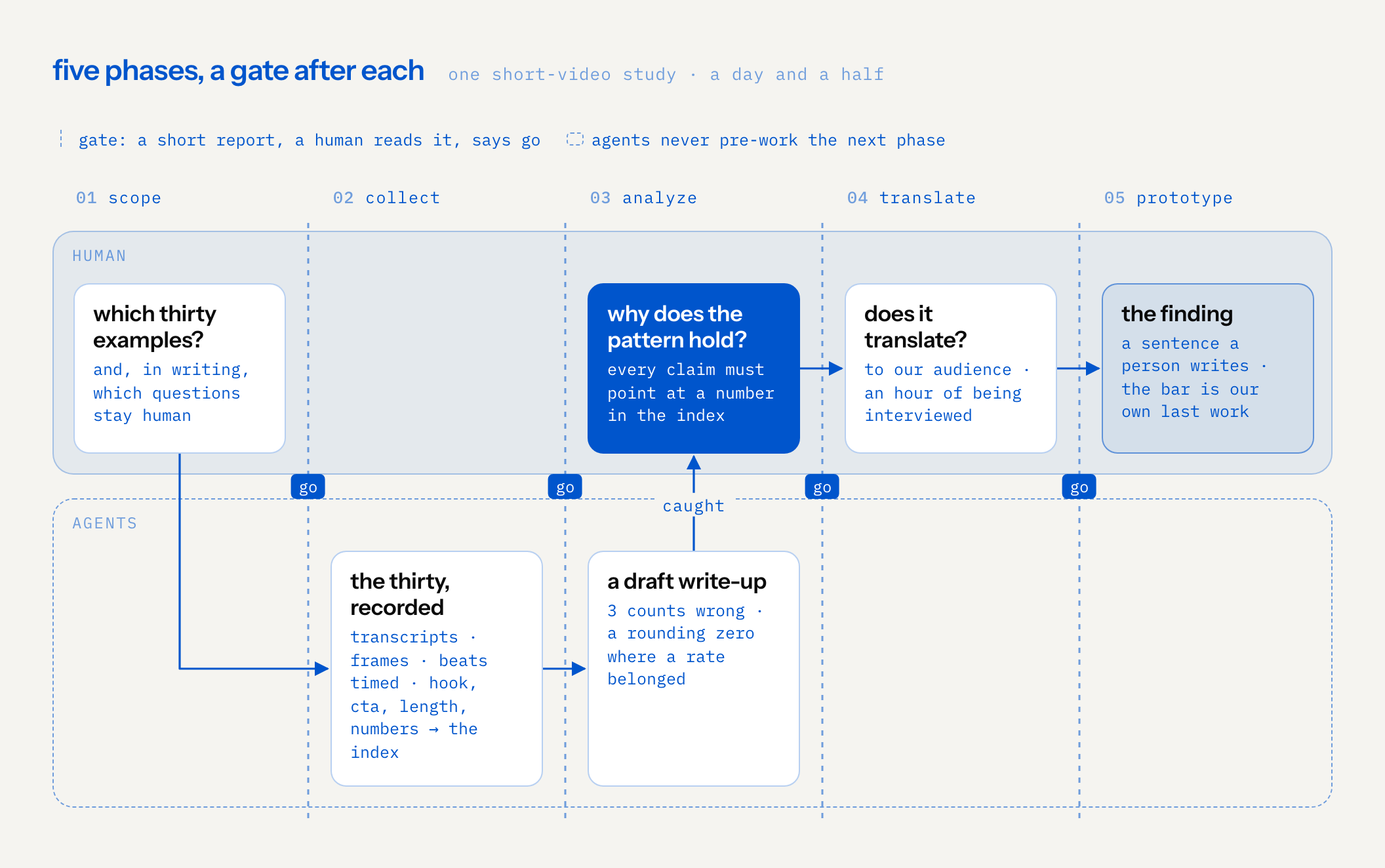
Phases, with gates. We run research as explicit phases — scope, collect, analyze, translate, prototype. Each phase ends with a short report and a stop. A human reads it and says go. The agents don't pre-work the next phase. This sounds bureaucratic and is the opposite: it's the only way to catch a wrong assumption in phase one before it's been multiplied across phase three.
Verify the analysis against the data. When an agent wrote up our video study, three of the counts in the draft were wrong, and a rounding error had produced a zero where there should have been a rate. We caught them because every claim in the write-up had to point at a number in the index. An analysis you can't trace back to its records is an opinion with a table on top.
Reference is not benchmark. The thirty examples we studied were the model, not the bar. The bar was our own previous work, with its own numbers. It's easy, once you've measured something impressive, to start judging yourself against it. The right comparison is you, before and after.
Delegate the mechanical, keep the judgment. "Which thirty examples" is a human question. "Why does this pattern hold" is a human question. "Does this translate to our audience" is a human question — and it took an hour of someone being interviewed to answer it. Transcribing is not a human question. Timing beats is not. We draw that line in writing, in the brief that starts the study, before anything runs.
what it changes
The obvious change: the research phase exists again. It's in the proposal as hours instead of as a sentence.
The less obvious change is what we can afford to ask. When measuring costs a week, you measure once, at the start, and you measure the big thing. When it costs an afternoon, you can measure before a decision instead of after it. Which thumbnail. Which length. Whether the thing you believe about your audience is still true this month. Small questions that used to be settled by whoever argued best in the room.
That's closer to what human-centered design was supposed to be. Not a ritual at the start of the project — a habit of checking.
the catch
- The agents produce the material, not the finding. In every study so far, the sentence that mattered — the one that changed what we built — was written by a person after reading the material, and it was usually a sentence the material didn't say out loud. "The house voice wins." "We over-produce." "Our words are in the wrong field."
- Cheap collection makes bad questions cheap too. You can now measure the wrong thing thirty times before lunch. The scoping conversation got more important, not less.
- A gate you don't actually read is just a delay. The phase reports only work if someone reads them before saying go. We've said go without reading. It cost a phase.