a living record.
Thoughts, experiments and proofs from inside the lab. These are the notes we keep while we work: what we make, what breaks, and what surprises us, published as we go. Not announcements; just the work, with the door open.
proof · 017 · latest
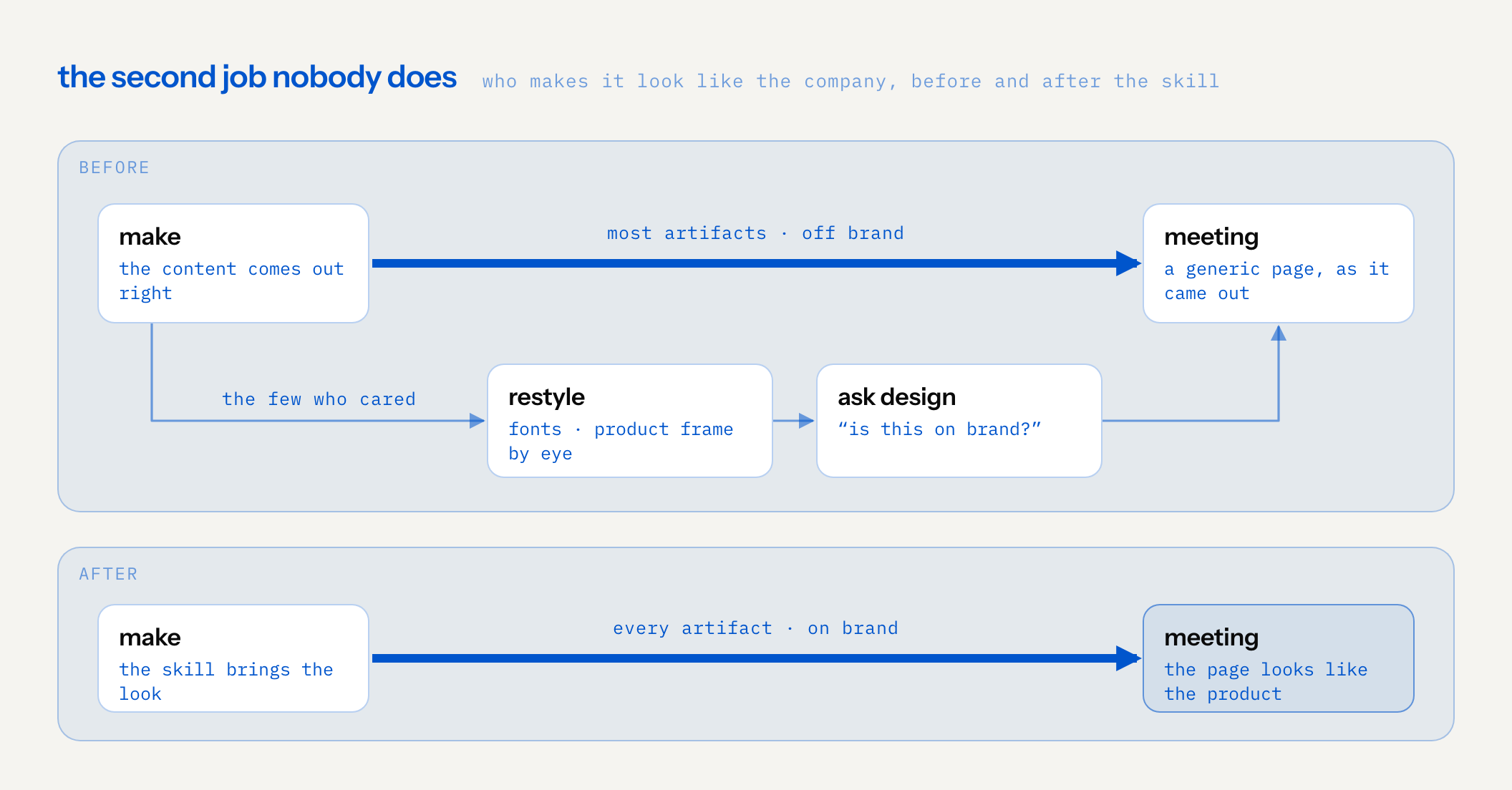
we stopped designing screens and designed how claude draws them
The content came out right and the look came out wrong, and mostly nobody fixed it. Making it look like the company was a second job, and it was nobody's priority. So we made the right look the default.
the artifact is the checkpoint: what we found inside a chaotic day with ai
We didn't plan a method. We had a pile of block variations, asks arriving mid-task and a hide button nobody could find. Partway through, we noticed that every time things got clear, a page was holding a decision. The chat wasn't.
agents are users too: stress-testing ai products with synthetic users
We ran 130+ scripted conversations against our own product before the client's team logged in. The first users were synthetic, and they found the bugs a client would have.
a synthetic usability lab for under three dollars
Our last tests asked models for an opinion. This one gave them a task and a browser, and watched where they got stuck. 36 sessions, under three dollars, and the fixes held.
two days a week, now about two hours: a newsletter that writes from the website
The newsletter goes to almost 90,000 people, sells a lot of BBQ and took our designer up to two days a week. We built a skill that writes it from the restaurant's own website, gets the small details right and leaves a [bracket] wherever the website is silent. The first real issue took about two hours.
let the ai interview itself: making a model grill its own plan
We already let the machine interview us. The other half of the method is making it interview itself: hard questions about its own plan, one at a time, until it can say which route it would take and why.
24 case studies in an afternoon (the prompt was the least interesting part)
Four agents, one day, 24 case studies rebuilt. The prompt was two lines. The actual product was a rules file, a status table, and a table of 34 questions the agents refused to answer themselves.
the mechanical half of research just got cheap
Every human-centered process starts with research on the whiteboard, and every small studio knows research is what gets squeezed when the budget is real. The mechanical half of it just got cheap. What you do with the other half is still the job.
let the ai interview you: writing a brief one question at a time
There's a moment in every project where the research is done and the brief still doesn't exist. We used to write our way out of it. Now we get interviewed out of it — one question at a time, by the machine.
reading a decade of your own group chat without inventing a history that never happened
Ask an AI to summarize a decade of group chat and it launders guesses into facts in the same calm voice. The fix isn't a better summary — it's refusing the summary entirely, and making every output a claim wearing a label that says how much to trust it.
structure-as-control beats prompt-roulette
The usual way to get a composition out of an image model is to describe it and re-roll until the dice land. Give it the geometry instead — and stop asking the slot machine to be your camera operator.
build by accretion: a make-and-show loop for visual work with ai
The honest version of working with an AI on visual things: drop one thing, look, adjust — and why that beats writing a big spec you can't picture yet.
you can't let an agent mark its own homework
We built a machine to stop us from believing our own agent's code works. The rule underneath it: a model can never be the judge of whether the model succeeded.
three companies, one brain, and a bot that brags
We gave three companies' nightly reports three different personalities — and the personality, not the automation, turned out to be the point.
nudge: a system to keep things moving
Most productivity tools quietly work against you — more pressure, more guilt. We built the opposite, and learned that friction is emotional before it's operational.
a shared innovation layer: one lab for businesses that can't pay eighteen engineers
Most businesses can't pay eighteen engineers to work out what AI should do for them, and they can't afford to wait either. This is the model we run instead, what it has produced so far and where it stops.
built from el salvador: the story behind capslock
Where the lab comes from, what building inside working companies taught it, and why it grows from El Salvador outwards.