We've written about letting the AI interview you: hand it the material, have it ask you one question at a time, each with a recommended answer, until the decisions are actually taken. That one is built on Matt Pocock's /grill-me skill. This note is its sibling. Same move, pointed the other way: make the model grill itself.
the plan you get back
Ask a model how it would build something and you get a plan. It's usually tidy, and it's usually agreeable. It answers the question you asked, in the shape you asked it, and it carries a layer of assumptions that nobody wrote down: who the thing is for, what already exists, what "done" means, which constraint it quietly decided didn't matter.
The other habit is the menu. Three options, a short table of pros and cons, "it depends on your priorities." It looks generous. It hands the hardest part of the work back to you, at the moment you have the least to go on.
Neither is a bad answer. Both are first drafts the model never questioned before handing over.
make it grill itself
So before anything gets built, we ask the model to interview itself about its own plan. The rules are the same ones the interview runs on, turned inward:
- One question at a time. A hard one, about the plan itself, written after the last answer.
- Each with its own recommended answer. Not "it depends." What it would do, and why.
- Argue the case against. The strongest version of why this plan is the wrong one, written as if someone else had to defend it.
- Name the assumptions. The things it would otherwise build on without saying so, as a plain list.
- Look for better routes. If a different approach beats the one it offered, say so, even if it means throwing out the first answer.
- Then pick one. One route, and the reason. No menu.
The questions are the kind a careful reviewer would ask. What would make this plan wrong? What am I assuming about the person who uses it? What's the smallest version that would tell us whether this works? If this fails, what's the most likely reason? None of them are clever. The point is that the model asks them of itself, in order, before you do.
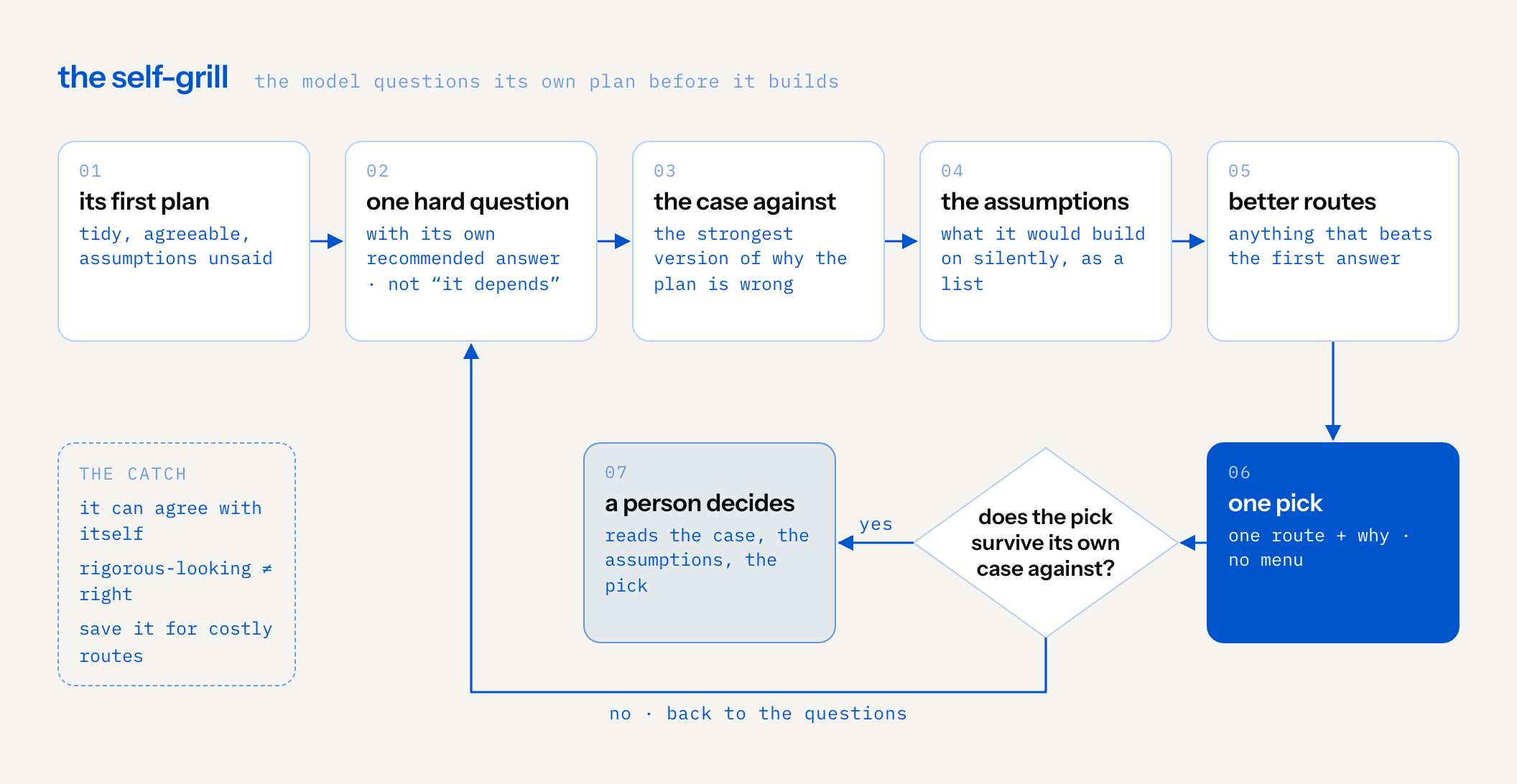
The last rule matters most. A model that grills itself and then hands back three options has done half the job. Being opinionated is the deliverable: here's the route, here's why, here's what would change my mind. You can still say no. But now you're reacting to a position, and as with the interview, the no you feel is information.
the order depends on how sure you are
The two methods aren't rivals. They're two halves, and which one goes first depends on one question: how sure are you about what you're building?
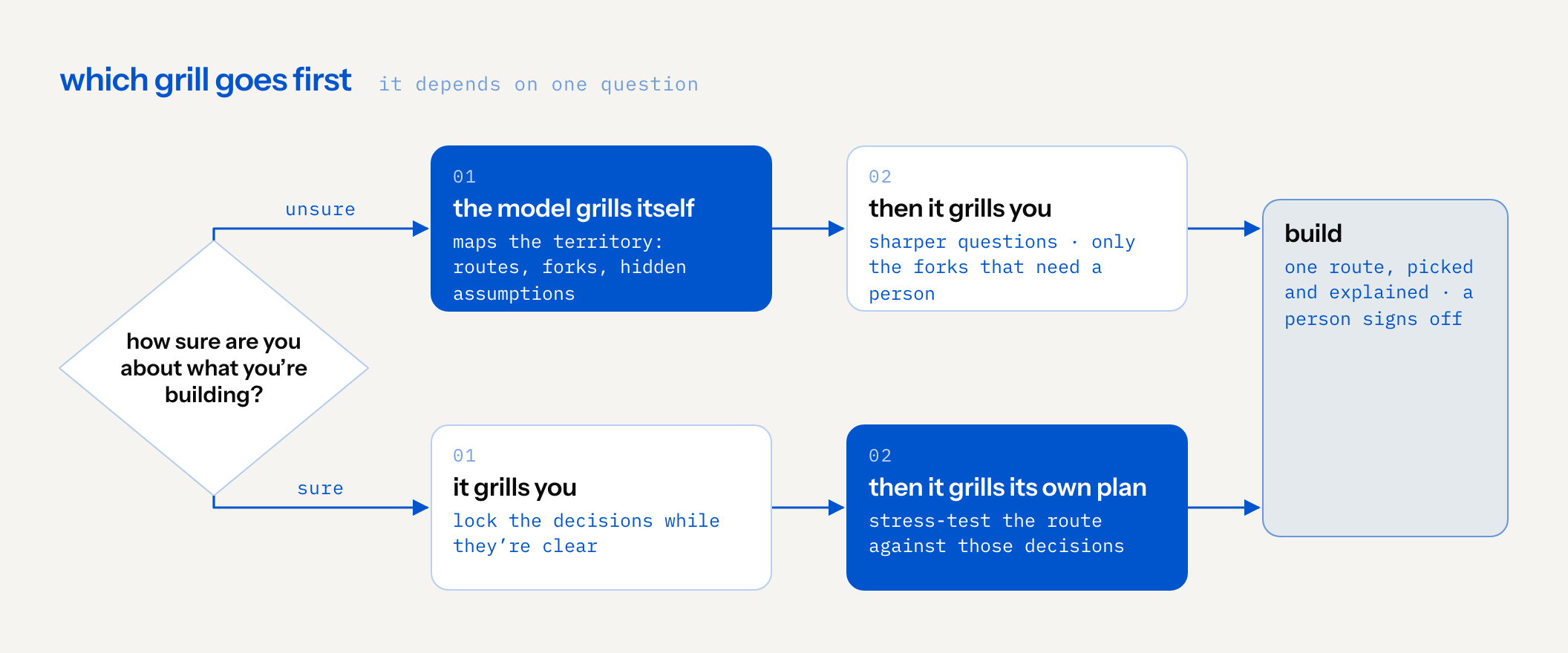
When you're unsure, the model grills itself first. It maps the territory: the routes, the forks, the assumptions hiding under each. Then it turns around and grills you, and the questions are sharper, because it now knows which forks actually matter and which ones it can settle on its own. You spend your answers on the decisions that need a person.
When you're sure, it grills you first, to lock the decisions while they're clear in your head. Then it grills its own plan against those decisions, to stress-test the route before a line gets written. The decisions are yours; the route still has to survive questioning.
We've used it mostly on the first kind: things we weren't sure about, where we couldn't have written a good brief yet. It worked, and better than we expected. We haven't measured it, so read that as an impression, not a result.
the catch
- It can just agree with itself. A model asked to argue against its own plan can write a weak objection and then politely dismiss it. That's a performance of doubt, not doubt. The same reason we don't let an agent mark its own homework applies here: self-review catches some things, and it can't be the last check.
- It burns tokens. Every question is a turn, every counter-case is text. On a small, obvious task, the grill costs more than it saves. We save it for work where a wrong route is expensive.
- It can look rigorous without being right. A numbered list of hard questions with confident answers reads like diligence. It's only as good as the material the model has. If the real constraint isn't in front of it, it'll grill itself thoroughly about the wrong things.
- A person still decides. The pick is a recommendation. The model can be opinionated; it can't be accountable. Someone who knows the work reads the case against, the assumptions and the pick, and says yes or no.
open questions
We don't know yet where the self-grill stops paying off. Some plans get better after one round and worse after three, as the model starts inventing problems to have something to answer. We also don't know how much of this survives a weaker model, or whether a second, separate model should be the one doing the grilling. Those are the next things to try.
related
- Let the AI interview you: the first half of the method, and Matt Pocock's
/grill-me, where it comes from. - You can't let an agent mark its own homework: why a model reviewing itself is useful and never enough.
- Build by accretion: the same instinct on visual work, reacting to something in front of you instead of a spec.