Every week, someone at 2fifty Texas BBQ asks the same question: do we have a photo of this? The marketing team asks it. So do the catering coordinator, the team looking for a reference, the owners.
It comes up before every newsletter, every story, every menu update, every time a new special goes on the board. The answer is usually yes. The restaurant works with one photographer, Sophie Macaluso, a food and hospitality photographer who shoots it regularly. There are 2,637 photos. Finding the right one, amongst all the beautiful, mouthwatering photos she has made for the restaurant, meant opening folders named by date and scrolling until something looked close enough.
Nobody would call that a process. It's a habit. It takes a few minutes each time, so it never makes it onto anyone's list of things to fix. That's exactly why it's worth looking at.
Small processes hide in plain sight
Big processes get attention. They have owners, budgets, meetings. The small ones don't, because each time they happen they look too small to matter: a search through a folder, a question in a chat, a file renamed by hand, a detail someone checks from memory.
But small processes have four things in common:
- They repeat. A few minutes, every week, for every person who needs the answer.
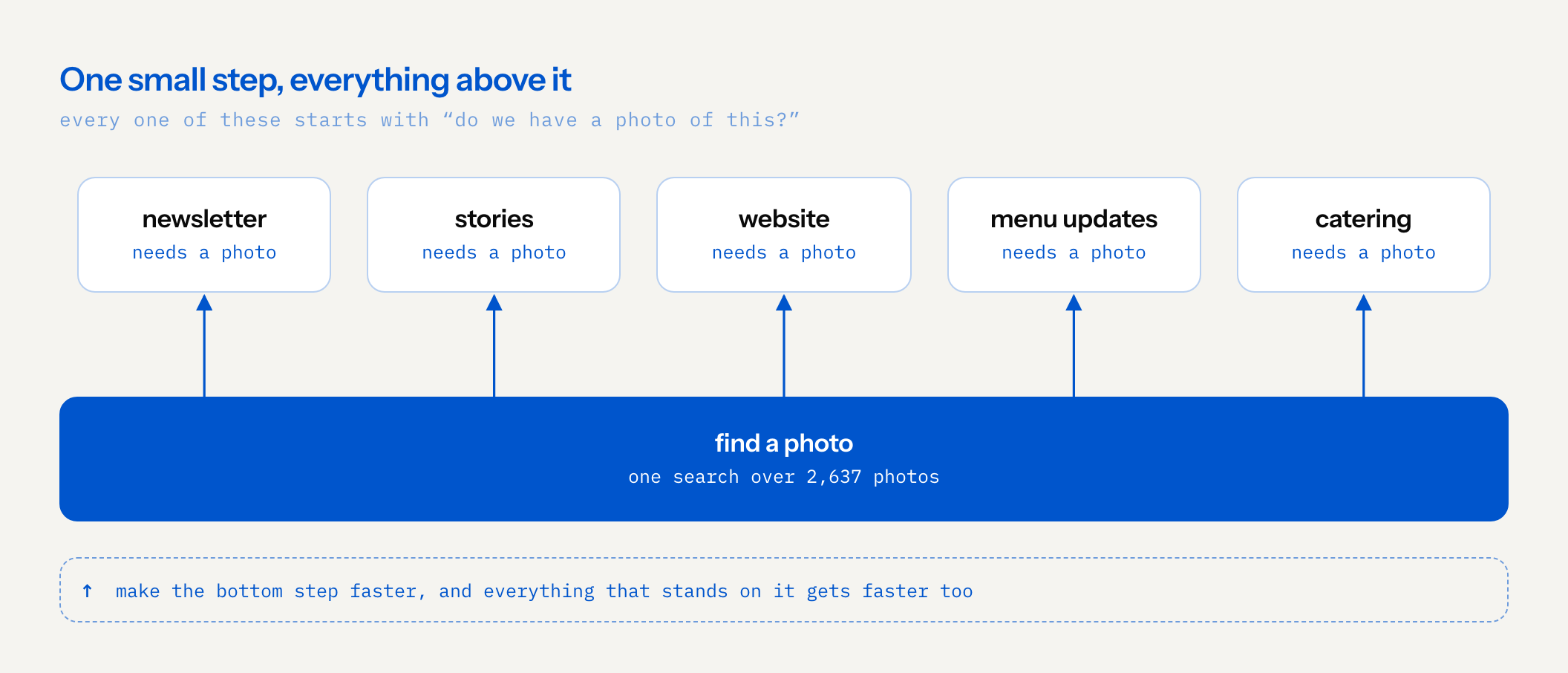
- Everything else depends on them. The newsletter needs a photo. So do the stories, the website, the menu boards. When the small step is slow, all of them are slow.
- They're where quality slips. When finding the right photo is hard, people pick the one they found last time. The same photos get used again and again, and good ones sit in a folder nobody opens.
- People start taking shortcuts. Everyone knows the one or two photos that are definitely right. So instead of going looking, they use those again, even when there are 200 others that would work just as well.
What cleaning one looks like
For 2fifty, we turned the question into a search. Every photo now has a description of what's in it: the dish, the place, what it's for. The team opens one page on the restaurant's own site, types "brisket" or "catering tray", and the photos are there. They can also browse the way they already think: what's on the menu, how it's sold, which location, behind the scenes.
None of it is complicated. Most of the work wasn't the search at all. It was agreeing on words.
Read as an image alone, a tray of sliced brisket and a whole brisket on the board are both "brisket". To the restaurant, they're different photos for different jobs: one sells a plate, the other sells the pit. A collaboration with another kitchen is real work, but it's noise when you're looking for this week's special. The restaurant had always known these things. They'd just never been written down, because nobody had needed to write them down until the answer had to come from a search instead of from someone's memory.
That's usually the real work in cleaning up a small process: making explicit what the team already knows. Finding the data, or organizing it, is usually half the solution.
The wins showed up in places we didn't expect
Speed was the obvious one. We don't have a clean before-and-after number yet; we're measuring it now. But the wins we didn't plan for turned out to be the interesting ones.
The team started teaching it. Anyone can add a word to a photo, or hide one that doesn't feel right for the brand, with a short reason. Those reasons are gold. They tell us what the restaurant doesn't want to look like, something no brand book had ever spelled out. The first round brought in 345 corrections.
People got their names back. The team can name who's in the photos, and a name only goes in when someone who knows them confirms it. Small detail, but now a story about the pitmaster can actually find the pitmaster.
Agents can search it too. The descriptions that let a person type "brisket" work just as well for an AI agent. The library is now searchable by people and by agents, so a tool drafting the newsletter can find its own photos instead of asking someone.
We know what to shoot next. With every photo described, we can see what's missing. Cross the library with what's selling in Toast, the restaurant's point of sale, and with what we're promoting, and we get a clear list for the next production: photos of the dishes that sell, and of the ones we want to push further.
We found work that had already been done. This one surprised us. When we looked closer at the photo files, we found that Sophie had already sorted them herself, with her own labels and ratings, on almost every photo. Nobody downstream had ever seen them. They'd been sitting inside the files the whole time. (Thanks, Sophie!)
Cleaning up a small process often does that. You go in to make something faster and you find out what's already there.
What the team said
We shared the library with the marketing team on a Monday. Nobody was asked for feedback in a form; this is what they wrote in the team chat over the next two days, translated from Spanish.
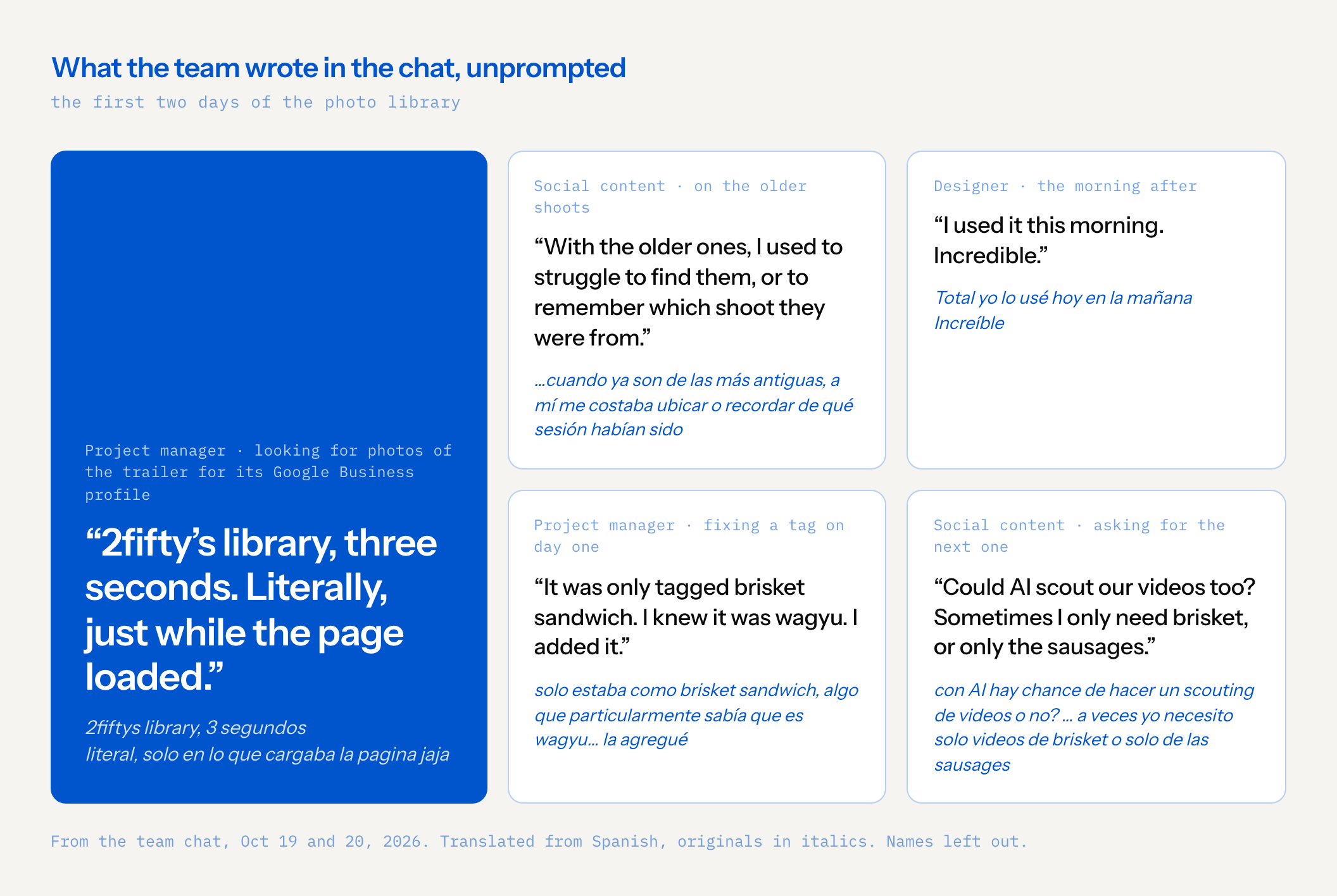
The corrections started on day one, and the next small process showed up on its own: could we do the same for our videos? That's 200 GB of raw footage, sorted today by downloading, keeping the clips used most, and deleting the rest.
Why small wins compound
The newsletter is the clearest example. We'd already set it up to draft itself from the restaurant's website, with the team curating and signing off every issue, and it went from up to two days a week to about two hours. Once that part was fast, picking the photos became the slowest step left. Fixing the photo question doesn't only help the photo question. The person making the marketing materials can search the library, and so can their agents, which can propose photos based on Sophie's own ratings, the proportions each format needs, and what the piece is for. It helps the newsletter, which helps the next issue, which helps the people reading it.
That's the pattern we keep seeing. One small process sits underneath several bigger ones. Clean it, and everything above it gets a little lighter, at once. You don't get one big win. You get lots of small ones, every week, and they add up.
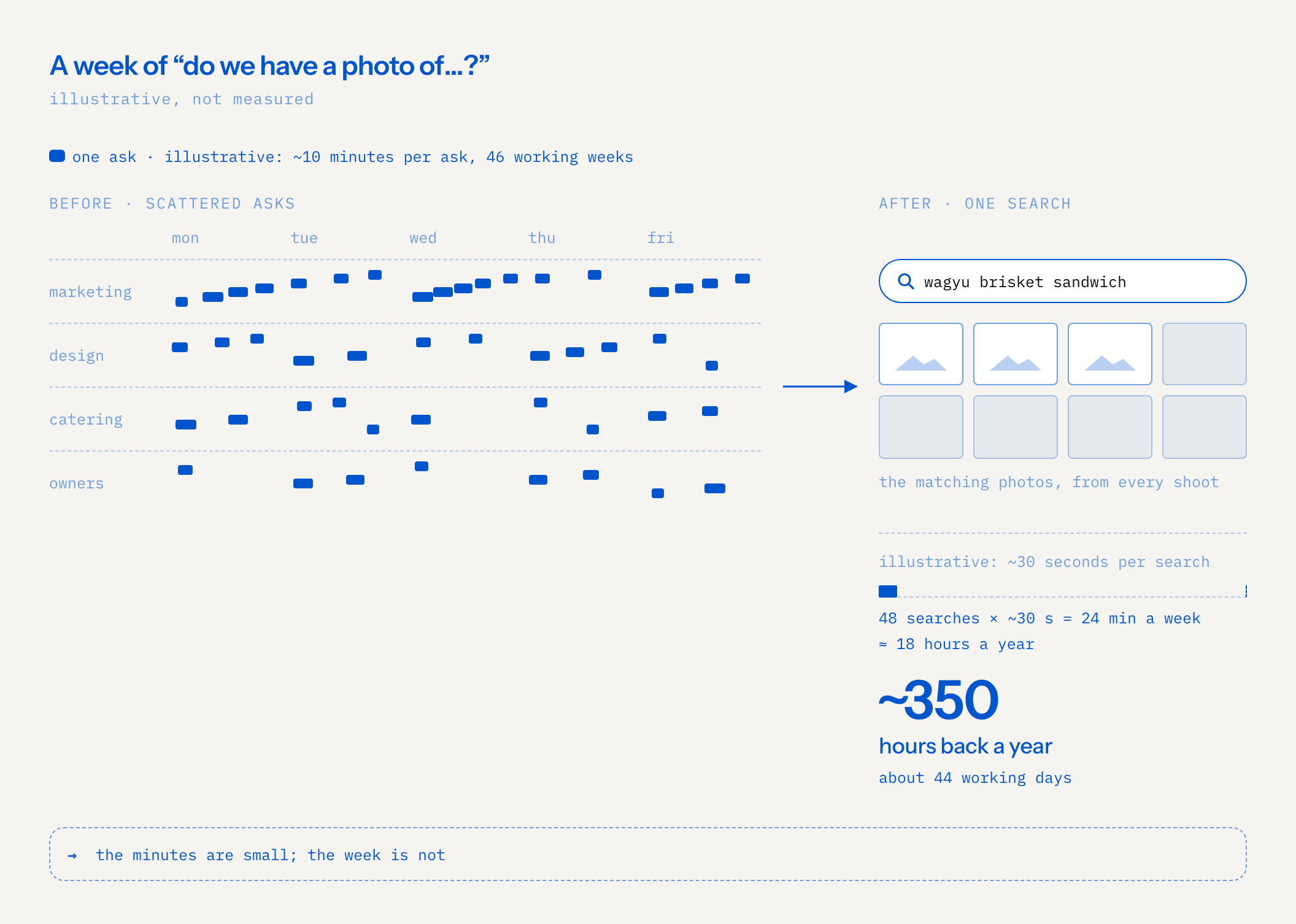
A week of “do we have a photo of…?”
illustrative, not measured
one ask · illustrative: ~10 minutes per ask, 46 working weeks
Before · scattered asksThe same asks, added up
× 46 working weeks
368 hours a year
about 46 working days
After · one search
wagyu brisket sandwich
the matching photos, from every shoot
illustrative: ~30 seconds per search
48 searches × ~30 s = 24 min a week
≈ 18 hours a year
~350 hours back a year
about 44 working days
the minutes are small; the week is not
How to find one in your own team
You don't need a big audit. Start with these questions:
- What does your team ask every week? Out loud, in chat, in a meeting. The repeated question is the process.
- Where does the answer live? If the answer is "in a few places" or "ask so-and-so", that's the one.
- Who knows it by heart? If one person is the search engine, the process breaks the week they're away.
- What slips when people are tired? The detail someone skips at the end of a long day is the one to make automatic.
Then pick one, and fix only that one. Small is the point.
What we don't know yet
We don't have the hours yet. We're timing real searches with the team, before and after, and checking the descriptions against people who know the menu. Until then, the honest claim is the smaller one: the question that used to take a scroll now takes a search, and the team uses it.