
what it is
Nudge is a system that keeps work moving inside a team. It lives in the channel the team already uses, reminds the one person who owns a task, and treats every reminder as encouragement instead of an alert. The lab designed it, and it runs every day inside El Fin, a studio we work alongside. It started as a reminder. It keeps picking up new jobs.
the question
What changes when a reminder's job is momentum instead of accountability?
Most tools that track work are good at tracking and bad at keeping people going. A list of overdue tasks is accurate and heavy. We wanted to know what happens when the same information arrives as a push forward instead of a debt.
how it works
it lives where the team already talks
There's no new app to open and no dashboard to forget. Nudge speaks in the team's own channels, and when something comes due it goes to the one person who owns it, where they already are.
it takes work in, not only out
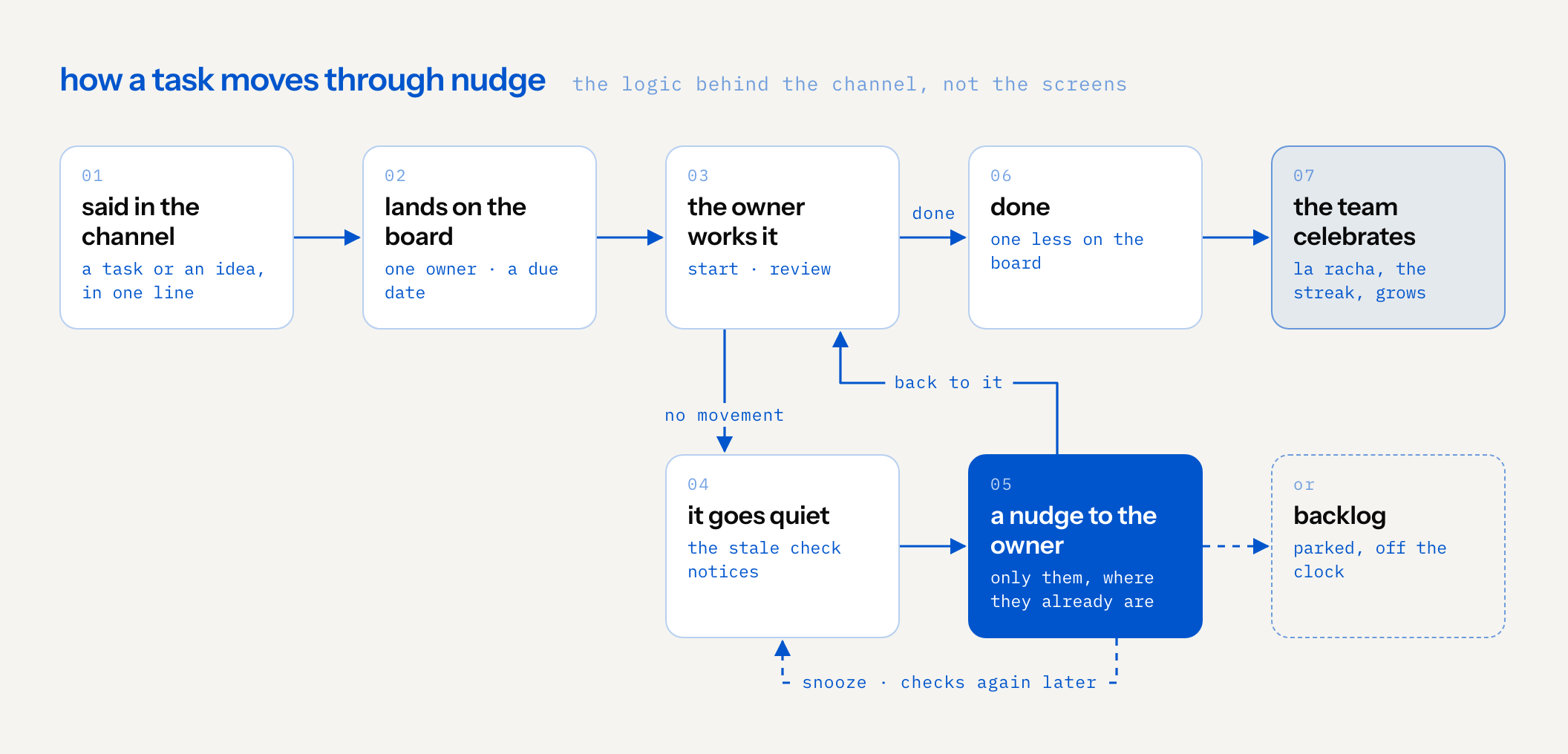
A task or an idea can be handed to Nudge in a single line, from the conversation where it came up. It lands on the right board with an owner, so the follow-up doesn't depend on someone remembering to write it down later.

it checks on what went quiet
Some work doesn't fail, it just stops. Nudge notices tasks that haven't moved, asks for feedback when a piece is waiting on someone, and keeps a small memory of what the team agreed, so the same decision doesn't get made twice.
it has a character, and it knows when to stay quiet
Nudge has a voice: a small, earnest robot that is a little proud of the team. It answers when someone talks to it directly, and it doesn't jump into conversations nobody invited it to. The operational messages (what's due, what's stuck) stay plain and predictable. The character is for the moments in between.
the ai built it, then mostly stepped back
Most of Nudge is well-timed plumbing on n8n, not a model watching the team. The AI helped us build it.
what we've learned
The real lesson is that the tone and the restraint are the product, more than any feature.
Every job Nudge picked up made it more useful, and every message it sent spent a little of the team's attention. We're learning to treat surprise and silence as real options, not as gaps to fill. A system that talks to a team every day has to earn each message.
The other thing we learned is where new jobs come from. None of them came from a roadmap. Each one started when the team caught itself doing something by hand, more than once, and noticed. Nudge grows by paying attention to that.
evidence
The change people noticed first wasn't the notification. It was not having to carry the follow-up list in their heads. We wrote that up in nudge: a system to keep things moving, along with what the first version got wrong: it pushed too hard, and tuning frequency and timing turned out to be the actual job.
The character side is in three companies, one brain, and a bot that brags: why a report with a point of view gets read when a dashboard doesn't.
You can see what Nudge is doing, live, on its own status page at nudge.el-fin.com. Where nothing measures something yet, the page says so.
status and limits
Running every day, and growing. A new job gets added when the team catches itself doing something by hand.
There are no hard metrics on Nudge itself yet. The two signals we're wiring up are whether people engage with the nudges and whether overdue work goes down. Until those exist, what we have is what the team tells us and what we see in the channel, which is useful and not proof.
what's next
The next step is a system that looks after itself. First it notices when something it should be doing has gone silent. Then it says so. Then, for a short list of known problems, it fixes them on its own and leaves a record of every fix, with a person deciding everything outside that list. After that, the two signals above, so the next version of this page can show numbers instead of impressions.